Robotic Sanding and Finishing
The same surface on the ten-thousandth part, with nobody breathing the dust.
Robotic sanding, grinding, and finishing for parts that need the same surface every time, with the dust hazard engineered out of the air.
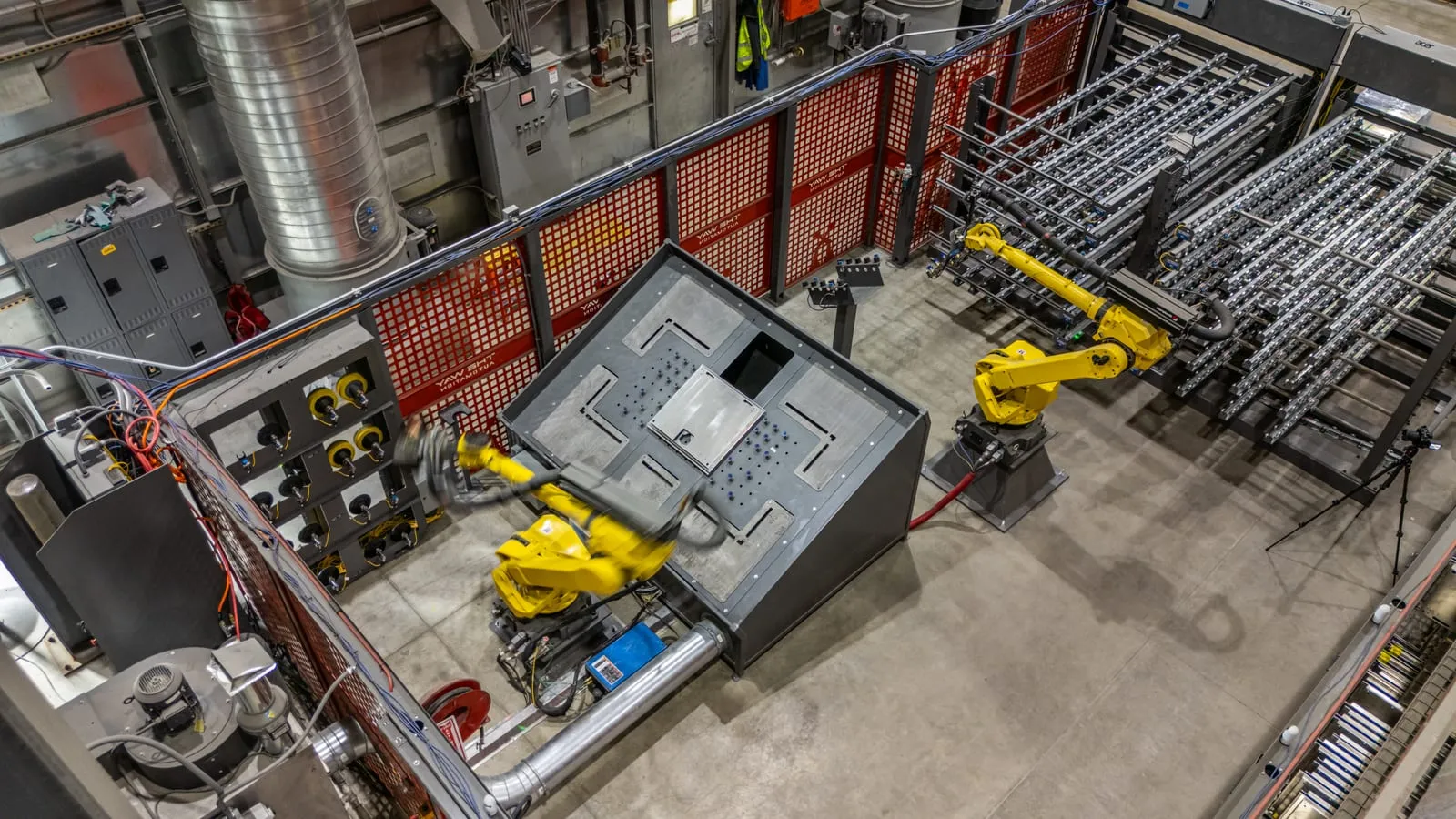
- Sanding, grinding, deburring, and surface prep on steel and aluminum
- One fixture table and a program per part, across 130-plus sizes
- Aluminum-dust ignition pathway engineered out, not just enclosed
- Proven at 100 doors a day, 19,700 doors by spring 2025
The problem
Hand sanding and grinding leave a surface that changes with who did it and when in the shift. The station is hard to staff and hard on the people at it, and where the material is aluminum, the dust is combustible.
What the cell does
A robot holds the part on a fixture and runs an abrasive along it with a force the program controls, pass after pass. Where the part family is wide, the cell is built for variety: one fixture table, a program per part, and a changeover the operator does in minutes. Where the material is aluminum, the cell is engineered so the ignition pathway is removed, not merely enclosed.
- Service body doors, 130-plus sizes. Two FANUC robots and one fixture table finished 19,700 doors by spring 2025 at 100 a day, with cycle time down from about 8 minutes to 5.5: the sanding cell study.
- Weld prep and deburr. Edges and weld seams prepared for paint or powder with the same pass every time.
- Handling and finishing in one cell. A second robot presents the part while the first finishes it, so a large panel is done in one fixture setup.
What it does not do
- It does not rely on a dust collector alone. The extraction, the media, and the enclosure are designed from the risk assessment for the material.
- It does not treat every shape the same way. Complex shapes take more programming, not a different cell.
- It does not skip the fixture work. Fixtures and media changeover are designed and built in our shop for your part family.
Questions we get on the first call
How does one cell handle over a hundred part sizes?
With fixturing and programs, not with a different robot per part: one fixture table, a program per part, and a changeover the operator can do in minutes. That is how the finishing cell runs 130-plus door sizes.
Aluminum dust is combustible. How is that handled?
By engineering the ignition pathway out of the cell, not by adding a dust collector to a robot. The extraction, the media, and the enclosure are designed from the risk assessment for that material.
What about parts that are not flat?
Force control keeps the abrasive against the surface as the geometry changes; the program follows the part model. Complex shapes take more programming, not a different cell.
Is this your station? Start with the Fit Check.
About a minute, with no contact information needed to see the answer. If it fits, we offer a first visit. You decide what happens after.