Robotic Welding
Consistent welds start with consistent parts. We build both ends of that.
Fixtured robotic welding cells for the assemblies you make every week, built by the team that automates the bending before them.
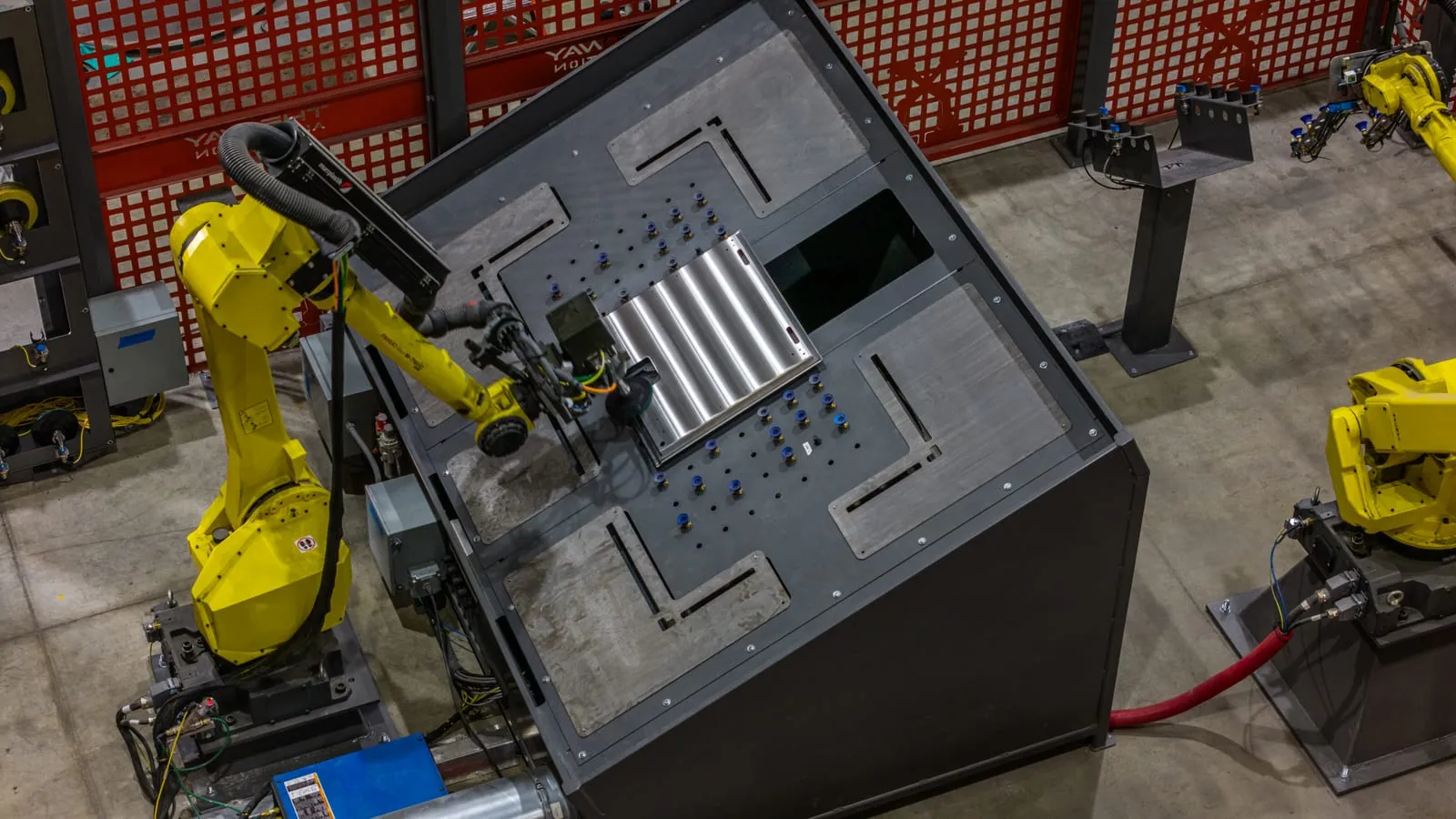
- Fixtured cells for repeat assemblies, cobot welders for smaller runs
- Fit-up solved upstream: the bending cell and the weld cell designed together
- Fixtures designed and built in our shop
- Programmed offline from the part model and proven in simulation before the first arc
The problem
A weld is only as good as the fit-up of the parts arriving at it. Wandering gaps, one-off parts, and a fixture nobody trusts make a robot weld what a person would have quietly corrected. When the parts are not consistent, the first job is upstream, and we say so.
What the cell does
A robot holds the torch over a fixtured assembly, runs the programmed path, and hands the finished weldment to the operator or the next station. Programs come from the part model, offline, so a revision is a new program. The welder who used to run one station runs the cell and inspects the work.
- Fixtured cells for repeat assemblies. Frames, brackets, enclosures, and tanks: one or two robots, a positioner where the geometry needs it, and fixtures built for the part family.
- Cobot welding for smaller runs. A collaborative welder that moves between jobs and is taught on the floor.
- Bending and welding designed together. On the Thunder Creek press brake cell, bends became consistent enough that the robotic welding line after them got more accurate too, per FANUC America’s published study: Thunder Creek, featured by FANUC America.
What it does not do
- It does not fix an upstream bending problem. No robot does.
- It does not suit one-off parts. Repeat volume, consistent fit-up, and a fixture you can trust make a weld robot-ready.
- It does not skip the fume and guarding work. Guarding and light curtains come from the risk assessment, and fume extraction is sized to the process.
Questions we get on the first call
Is my weld ready for a robot?
Consistent fit-up, repeat volume, and a fixture you can trust make a weld robot-ready. Wandering gaps and one-off parts do not, and no robot fixes an upstream bending problem. The Fit Check and the first visit answer this honestly before anyone spends money.
Cobot welder or fixtured cell?
Volume and variety decide. A cobot welder suits smaller runs and frequent changeover; a fixtured cell wins when the same assembly runs all week.
Who programs it when the part changes?
The programs come from the part model, offline, so a revision is a new program, not a day of teaching. TWA supports the cell from Bixby, Oklahoma, after go-live.
Is this your station? Start with the Fit Check.
About a minute, with no contact information needed to see the answer. If it fits, we offer a first visit. You decide what happens after.