Material Handling and Palletizing
The parts too big, too heavy, or too awkward to keep moving by hand.
Robots that move parts between processes: long rails, heavy vacuum tooling, pallet exchange, and safety that lets people work beside them.
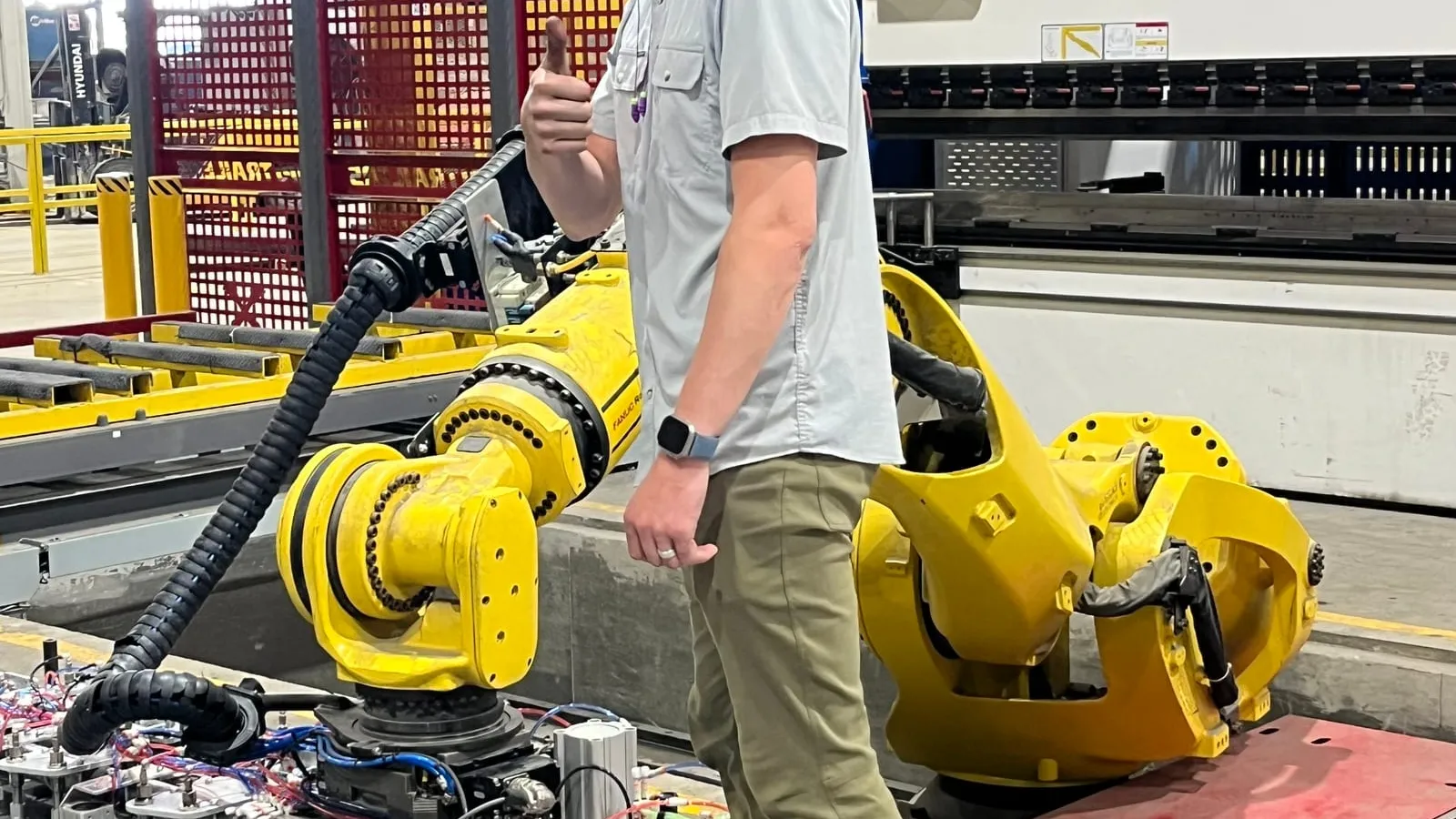
- Rail-mounted robots up to 20 meters of travel
- Vacuum, magnetic, and mechanical tooling sized to the heaviest and longest part in the family
- Pallet, cart, and conveyor exchange without stopping the robot
- Tiered safety so people can work beside the cell
The problem
Some parts are too big, too heavy, or too awkward for a person to keep moving all shift: trailer plate, enclosure panels, vessels, long sheet, cast parts. If two people are carrying it, or one person is carrying it wrong, the handling is the job.
What the cell does
The robot is chosen for the heaviest part it will ever lift, the rail for the farthest it will ever reach, and the tooling for what the part will tolerate. Palletizing is the same discipline at the end of the line: a stacking pattern the truck can take and an exchange the operator does without stopping the cell.
- Heavy plate on long rails. Sixteen-foot panels over five hundred pounds, handled on a ten-meter recessed rail through three to five bends, for a Texas trailer OEM: the heavy tandem study.
- Wet parts, long reach. Sixteen-foot vessels wet with resin, carried on a twenty-meter rail with three tiers of safety, for a clean-fuel component manufacturer: the vessel handling study.
- Palletizing. Cases, bundles, and finished parts stacked to a pattern, with pallet exchange the operator handles from outside the guarding.
What it does not do
- It does not move a part it was not sized for. The robot and the rail are sized to the heaviest and longest part in the family, not the average.
- It does not ask people to stay away. Guarding, light curtains, and area scanners in tiers let people work beside the cell, and the risk assessment decides the layout.
- It does not use one gripper for every material. Each part gets tooling built for what it will tolerate.
Questions we get on the first call
How heavy and how long can the robot handle?
Cobot arms for the light, repetitive work and heavy FANUC arms on rails for the big sheets; the robot and the rail are sized to the heaviest and longest part in the family, not the average. On one trailer project the cell handles sixteen foot panels over five hundred pounds.
Can people work inside the cell area while it runs?
Beside it, yes, when the safety is engineered in tiers: guarding where the robot cannot be approached, light curtains and area scanners where people load and unload, and safety-rated robot speed and position monitoring behind both. The risk assessment decides the layout.
What if the part is wet, hot, or delicate?
The tooling is designed for the material. Resin-wet vessels, freshly formed panels, and finished surfaces each get a gripper built for what the part will tolerate, in our shop.
Is this your station? Start with the Fit Check.
About a minute, with no contact information needed to see the answer. If it fits, we offer a first visit. You decide what happens after.