Case study · Robotic Machine Tending · 2025
A 30 Part Order Unattended on a Legacy Tube Bender
A one-off CNC tube bender, a harsh floor, and a fabricator who wanted the job worth running. A FANUC cell on a rail runs full orders unattended.
- 30 partsFull order, unattended, nobody from TWA on site
- 125 kgRobot payload on the rail
- 5 to 6 inTube outside diameter handled
- 17False safety trips caught on one visit
What you told us
The shop runs one of the highest-volume tube bending operations in the country, and its owner invests in his people. Loading and tending the bender was the job nobody wanted: heavy five- and six-inch tube, lifted in and pulled back out by hand, all shift. It was the hardest station on the floor to keep staffed.
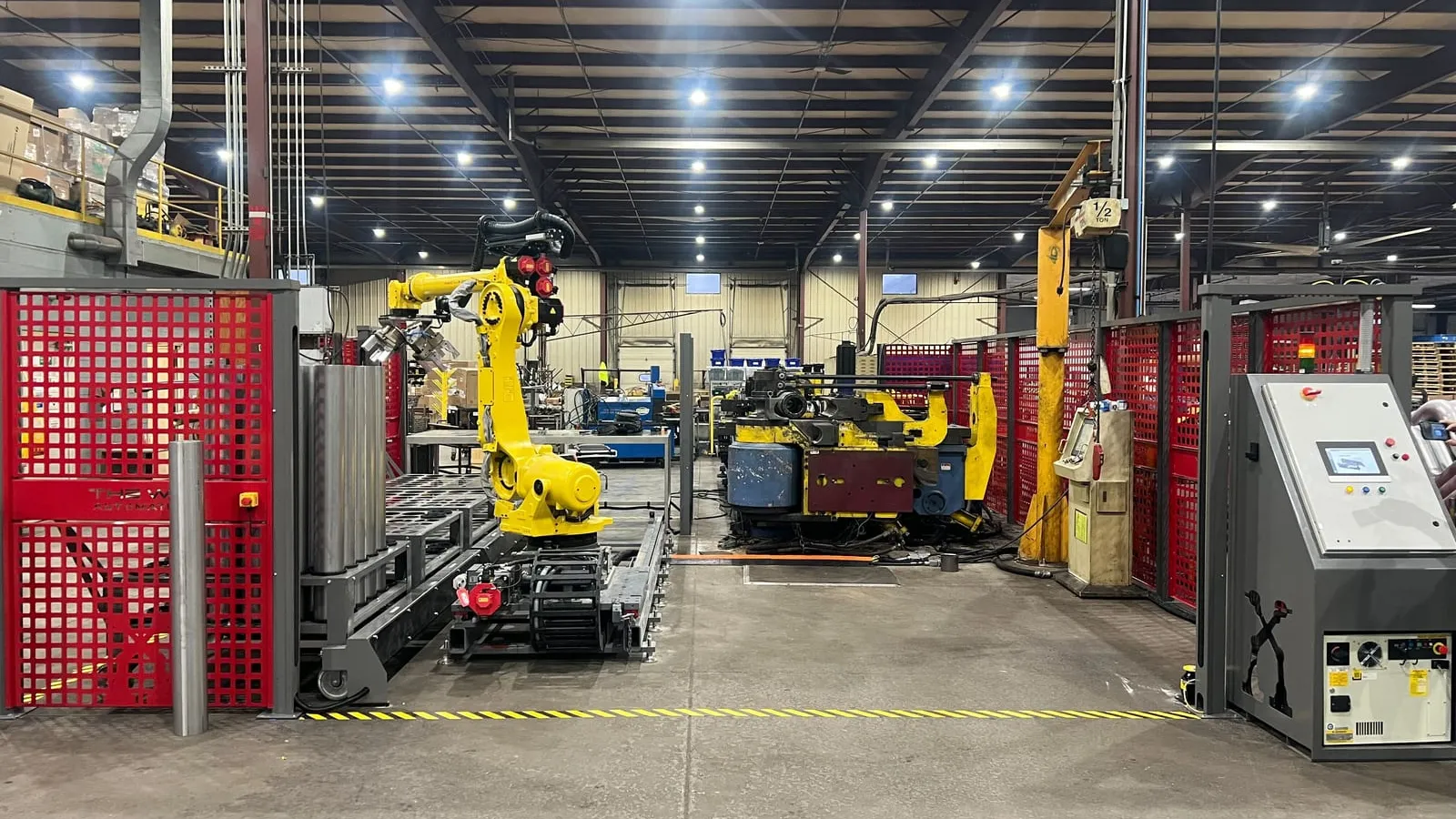
The machine made it harder. The bender was a legacy CNC unit, a one-off with outdated documentation, and purpose-built robotic tube bending barely exists on the market. Add reflective metal-flake grease in the air and hand grinding one bay over, and most integrators would have passed.
The owner did not want the operator out of the picture. He wanted the job worth running, and his people doing setups and quality instead of lifting tube.
What we built
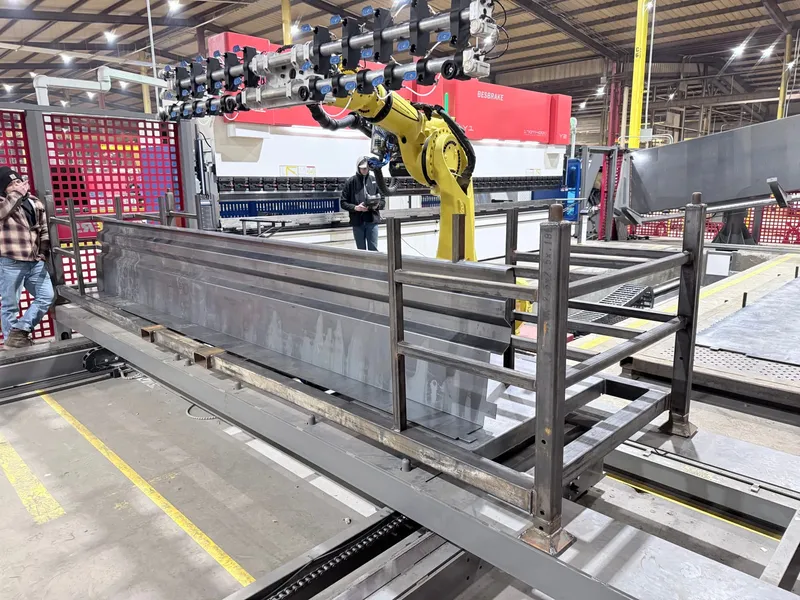
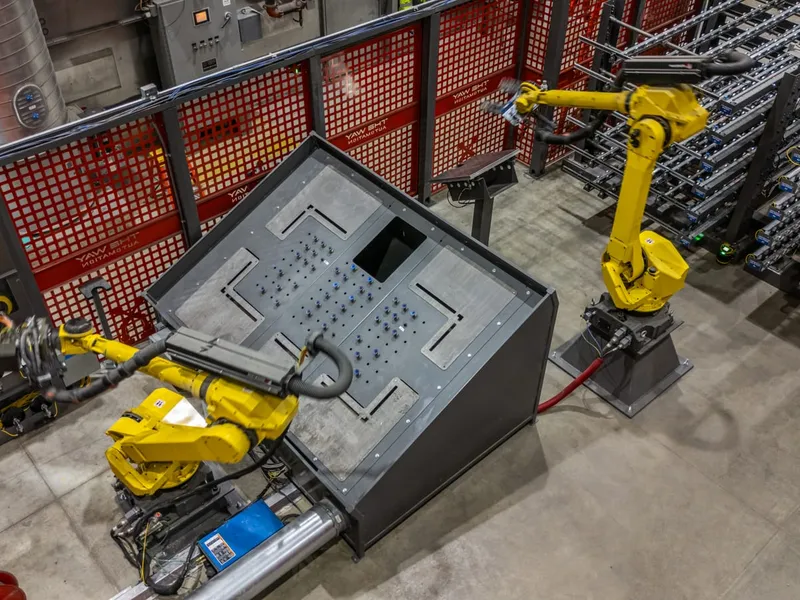
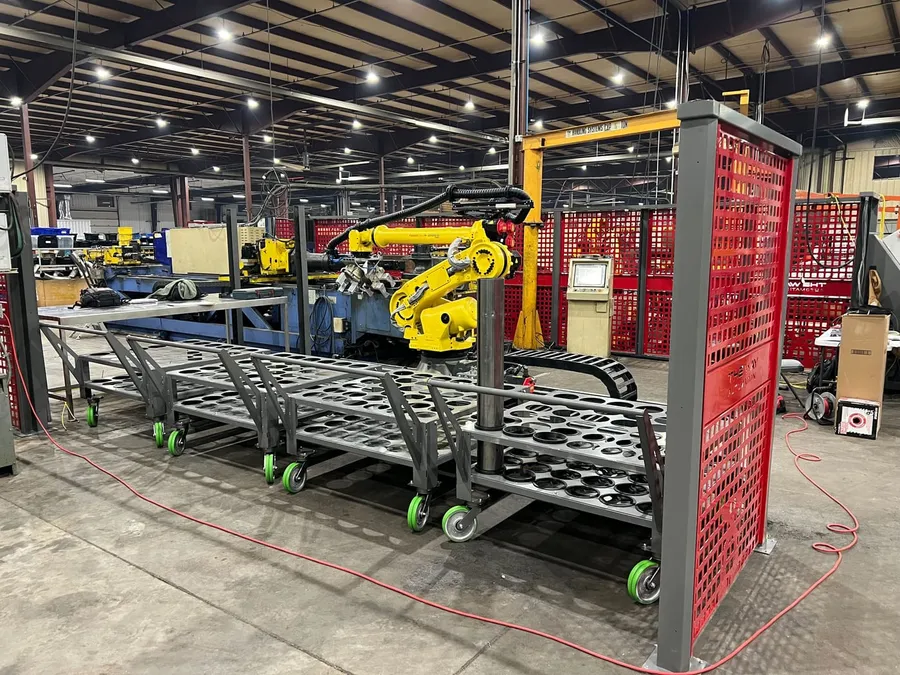
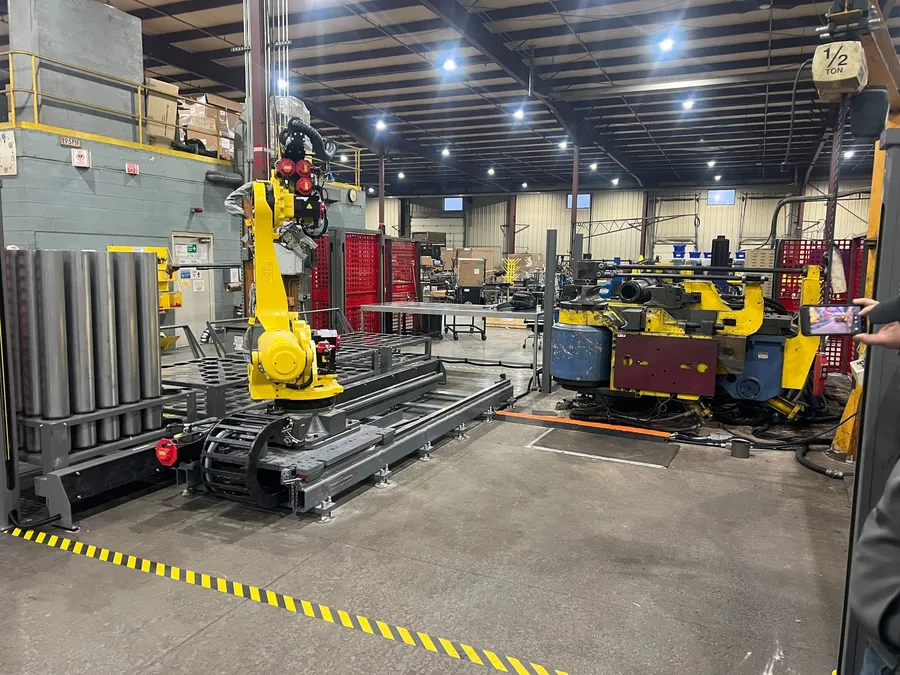
A FANUC R-2000iC/125L, a 125-kilogram long-reach arm, rides a seventh-axis rail from the infeed carts to the bender and on to the outfeed. Four infeed carts with magnetic docking plates let the operator stage a run in minutes, then step away. A dual gripper picks a raw tube, regrips it on a zero stand so the robot knows exactly where it is, feeds the bender, waits out the bend, and sets the finished part on the outfeed. The bender stays the master in the handshake; the robot follows its cycle.
Delivery was turnkey: fencing and light curtains, the operating procedure, maintenance manuals, as-built drawings and control schematics, and operator training in tiers from operator to super-user.
The floor fought back after go-live. The area scanners were tripping on grease particles in the air and on grinding sparks, and each trip stopped the line. We root-caused it on site, tuned the filters, and added muting logic that arms the scanners for the first seconds of a cycle and mutes them until the next one. On one return visit that caught 17 false trips.
Who we worked with
A regional machinery dealer made the introduction and stayed in the loop through commissioning. The bender’s maker and its service dealer worked the machine side of the handshake with us. FANUC built the robot; we are a FANUC Authorized System Integrator. The cell design, tooling, controls and training were ours.
What came next
The cell went live in July 2025, and the first full order ran unattended the next day. The shop then bought a newer bender of the same class and asked us to automate it too. A second cell is in engineering with the customer’s own production team shaping the layout, and they are training internal leads to run it.
Where that goes after the second cell is their call. The first cell did its job, which was to make the next decision easy.
Your station next
Start with your own station
The Fit Check takes about a minute on your phone. You see the answer first, and you decide what happens next.