Case study · Robotic Material Handling · 2026
Sixteen Foot Vessels Wet With Resin: A Clean Fuel Handling Cell
Composite pressure vessels up to 196 inches long, wet with resin, were moved by hand. A robot on a 20-meter rail now carries them.
- 196 inLongest vessel the gripper carries
- 20 mSeventh-axis rail travel
- 3Safety tiers, one controller
- 4Liner designs, no tooling change
What you told us
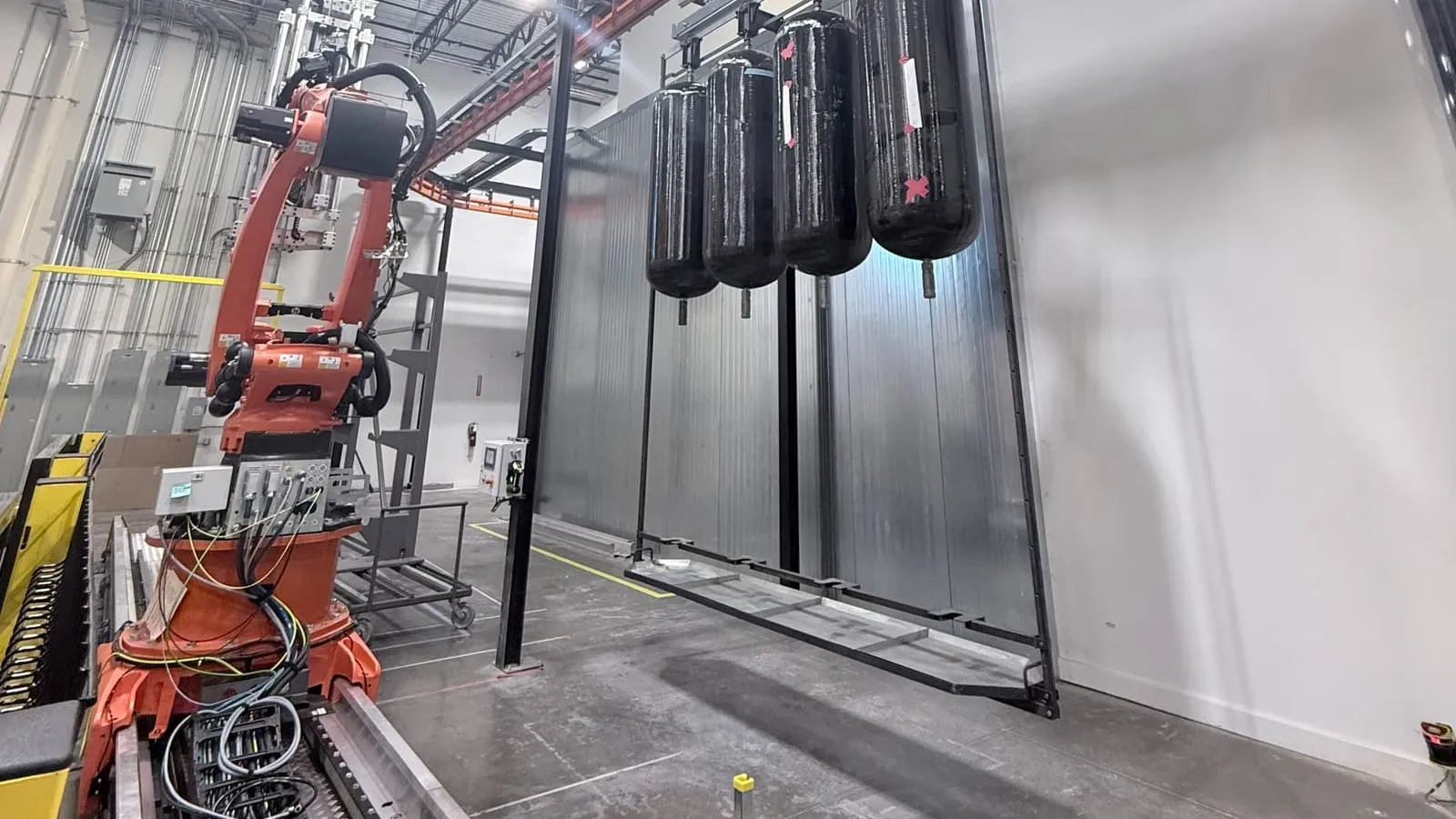
The plant makes Type IV composite pressure vessels, the carbon-fiber wound tanks that store natural gas fuel. A liner is wound with resin-wet fiber, cured in an oven and tested before it ever holds pressure. Between the liner station, two winding machines and the oven sat a chain of manual moves: heavy, differently sized vessels, wet with resin, lifted and staged by hand under some of the strictest safety standards in manufacturing.
Keeping two winding machines fed in alternation, by hand, was the ceiling on the line. The ask was a handling system that moved the vessels safely, kept both winders fed, and never, under any fault, let a vessel fall.
What we built
A heavy-payload six-axis robot on a 20-meter seventh-axis rail, traveling the line to serve both winding machines and the oven infeed. The end effector adjusts to four liner designs up to 196 inches long, with a locking mechanism and redundant safety circuits on the locking collars so a vessel cannot come free, and drip management for parts that arrive wet.
The cell runs under a three-tier safety architecture: a handling zone, hard guarding, and an optical barrier with a stopping-distance zone, using safety laser scanners, light curtains and interlocked gates under one safety controller. A central HMI selects full or partial loads and automatic or semi-automatic sequencing, and the robot signals the winding machines to lock and unlock as it arrives and leaves.
The sequence is the point of the rail: liners to one winder, back for the second, wound vessels on to the oven. No two people could sustain that rhythm by hand for a shift. The equipment is on the floor and the cell is in final commissioning as of this edition.
Who we worked with
The winding machines came from a specialist machine builder, and the signal map between the cell and the winders was worked out with that builder. The safety components come from one maker so a single controller supervises every zone. No dealer introduced this project; it began with a conversation at a trade show and a plant visit. Design, end effector, controls, safety architecture and on-site integration were ours.
What came next
This was a long project, roughly two years from purchase order to final commissioning, and we would rather say so than imply a quick install. What comes next is the customer’s production start, on their schedule. Nothing here states production results, because the cell has not been released to production.
Your station next
Start with your own station
The Fit Check takes about a minute on your phone. You see the answer first, and you decide what happens next.